
Oakland Previous Residents Sources by Era
No single Oakland source lists every person who used an address. Deeds establish a title trail, while directories, census schedules, voter registers, obituaries, and maps add dated clues about households and buildings. The table separates the source's time span, keeper, and use so a past-resident search does not confuse an owner with an occupant.
| Source | Years It Covers | Where Held | What It Shows |
|---|---|---|---|
| Alameda official public records | 1853-present; web name index 1969-present | Alameda County Clerk-Recorder, 1106 Madison Street, Oakland | Recorded instruments, parties, dates, legal descriptions, and title locators |
| Assessor Parcel Viewer | Current parcel data | Alameda Assessor online viewer and counter | APN, situs address, parcel geometry, map references, and ownership clues where shown |
| Oakland city directories | 1869-1943, with listed gaps | Oakland History Center and digitized holdings | Alphabetical names, addresses, household clues, occupations, and businesses |
| Oakland reverse directories | Selected 1936-1995 years; online links for 1938, 1940, and 1944 | Oakland History Center, Main Library Magazine & Newspaper Room, and selected scans | Address or phone to a listed occupant or subscriber |
| Federal census schedules | 1870-1950 public schedules | National Archives and library genealogy databases | Dated households and enumeration order, including nearby households |
| Tax assessor block books | 1877-1925 | Oakland History Center Map Room | Historical owners, values, and parcel evolution |
| Sanborn maps | Various and incomplete, 1882-1958 range | Oakland History Center Map Room and Library of Congress collection | Building footprints, construction materials, uses, and old street labels |
| Oakland permits and code records | General online records after 1987 | Oakland Online Permit Center; older files through city records requests | Construction dates, descriptions, status, and disclosed contacts |
| Obituary files and probate | Obituary index 1951-1993; probate coverage varies | Oakland History Center and Alameda Superior Court eCourt | Death, relatives, heirs, petitions, and estate actions |
Start with the source that matches the question. A title question begins with the parcel and deed chain. An occupancy question begins with the reverse directory or census. A building question begins with maps and permits. A family question may end in an obituary or probate file. The most reliable Oakland previous residents timeline uses more than one of these layers.
The California vital-records custodian page explains the statewide route for events from July 1905, while the 2026 CDPH fee schedule gives the current state copy amounts. The California State Archives county and city records inventory identifies Alameda County marriage microfilm from 1854-1955, another possible family link when a household trail reaches a marriage record.
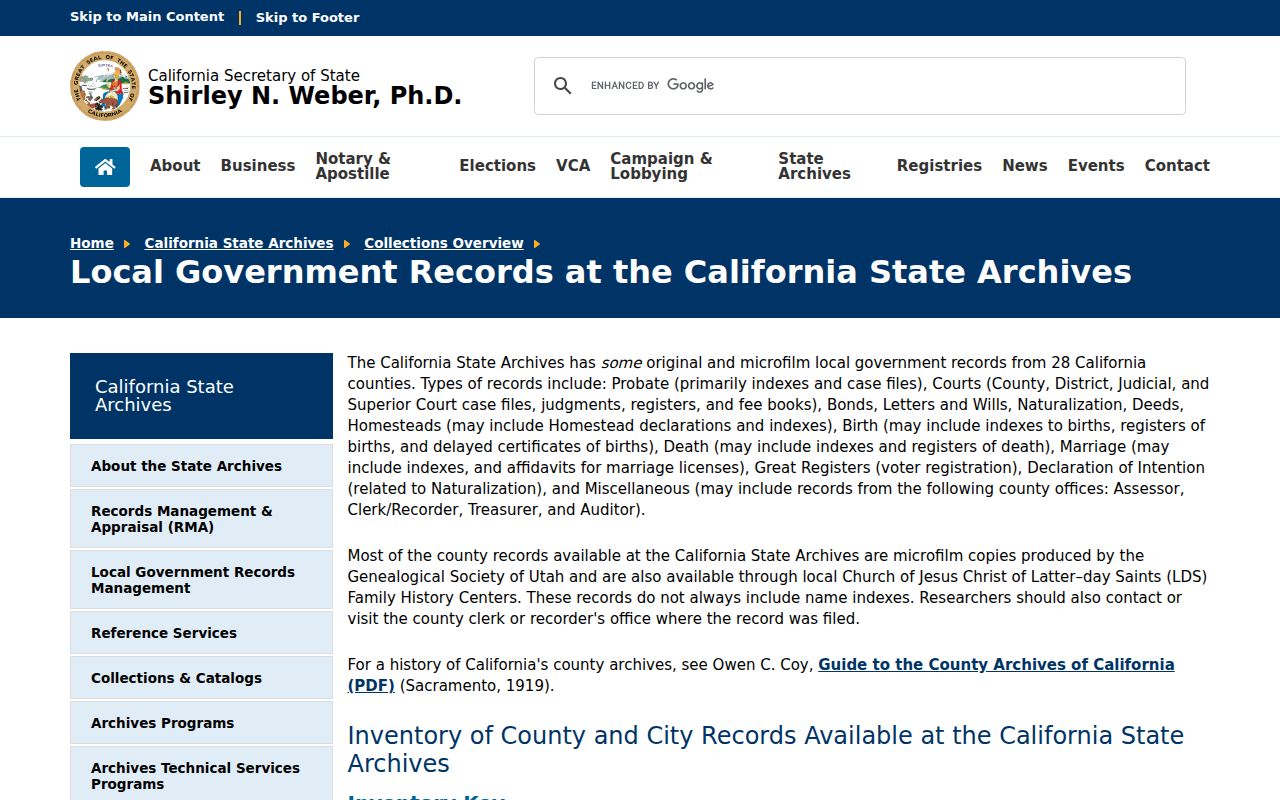
The archive view is a reminder that a local address trail can lead to a state or county collection when the Oakland shelf alone does not answer the family question.
Start an Oakland Previous Residents Search
Begin with the physical address, not a guessed name. The Alameda Assessor Parcel Viewer accepts an address or APN and shows parcel boundaries, dimensions, acreage, street addresses, and map references. It is assessment cartography, not a legal survey. Record the normalized situs address and APN, then note whether the map shows a subdivision, combination, or other change that could have produced an older APN.
Keep three identities apart. Situs is the physical property location used for administration. Mailing address is where a tax notice goes. Legal description is the land identity recorded in an instrument. An owner or taxpayer shown in an assessment product is a clue about title, not a complete list of earlier occupants. A different mailing address may point to an absentee owner, trust, manager, or chosen correspondence address without proving where anyone lived.
Oakland GIS can add planning geography, ZIP, parcel, zoning, and district context. The City of Oakland GIS MapServer confirms the ZIP-code layer, but GIS orientation does not replace the assessor or recorded instrument when a title chain matters.
Oakland's 1969 Deed-Index Cutoff
Alameda County official public records date to 1853, but the electronic name index covers 1969 to the present. The index is organized around parties named in the document, normally grantors and grantees. It is not searchable by street address or APN. That 1969 cutoff is the central numbers clue in an Oakland address-history search: the web can start the modern chain, but older work moves to the Madison Street counter.
The Alameda County Official Public Records portal supports online, mail, and in-person order routes. The index is free to inspect. Plain copies are $3.50 per page. Certified copies cost $4.50 for the first page and $3.50 for each additional page. The office says new documents can take about two weeks to become orderable, so a recent transfer may not appear at once.
For 1853-1968, research is in person even though the books reach back to the county's creation. Bring a known party name, approximate date, and any book, page, reel, image, or instrument locator already found. The office phone is 510-272-6362 or 888-280-7708. Ordinary recorder copies follow the recorder's own ordering process; a broad California Public Records Act request is not a substitute for a known deed copy.
Trace Oakland Previous Residents Through Deeds
A deed chain can show prior owners of an Oakland property, but it cannot by itself identify everyone who lived there. Start with the current parcel information, then move from the present owner as grantee to the earlier owner as grantor. Validate each step against the legal description, lot or block information, and recording locator rather than chaining on a repeated surname alone.
- Enter the Oakland address or APN in the Assessor viewer and save the current situs, APN, map reference, and any visible owner or taxpayer clue.
- Search the current owner as a grantee in the Alameda recorder index around the likely acquisition period.
- Open or order the acquisition deed and record its grantor, grantee, recording date, instrument number, and legal description.
- Search the grantor as a grantee at an earlier date, then compare the next deed's legal description with the same parcel.
- Repeat through the 1969 online boundary, then continue with the alphabetical 1853-1968 index and deed books at 1106 Madison Street.
- Grantor and grantee
- The grantor transfers or records an interest; the grantee receives or is named as the recipient of that interest.
- Chain of title
- The linked sequence of recorded transfers used to follow ownership from one party to an earlier party.
- Legal description
- The recorded land identity, such as lot, block, subdivision, or another description that can outlast a street-name change.
- Criss-cross directory
- An address-ordered or phone-ordered directory used to look for an occupant rather than a deed owner.
A deed of trust identifies borrowers and lenders, not all household members. A reconveyance shows a payoff event. A lien or judgment can confirm a name and record relationship, but each instrument must be read for its own purpose.
Oakland Reverse Directories for Past Residents
When the question is who lived at an Oakland address, a reverse directory is usually more direct than a deed index. The Oakland History Center lists 1936, 1953, 1961, 1964-1974, and 1995 reverse volumes, with digital links for 1938, 1940, and 1944. Later volumes are in the Main Library Magazine & Newspaper Room. Browse the target street and number, then check nearby numbers for block context.
The reverse entry may represent a listed occupant or telephone subscriber. It is not the same as a recorded owner, and omission can reflect the limits of that volume. Once a name is found, use the alphabetical city directory for the same era to look for a spouse, occupation, second address, or household convention. The complete Oakland city directory collection and entry-reading method are described on the Oakland city directory page.
Keep the year and page with every result. A reverse directory can reveal a whole historical block in one browse, but it cannot turn a partial listing into a current resident roster. For Oakland previous residents, it is a dated occupancy clue that should be paired with a different record.
Oakland Block Books and Sanborn Maps
Tax assessor block books held in the Oakland History Center Map Room cover 1877-1925. They can add historical owners, values, and parcel evolution to a chain that is hard to read from modern APNs. Sanborn maps in the local collection cover various and incomplete years in the 1882-1958 range. They show building footprints, materials, uses, and street names, helping connect a historic number to a physical structure.
The Library of Congress Sanborn map collection provides background on the map series and its digitized access. Compare a Sanborn footprint with the OHC map-room material when a building changed, a rear lot interrupts the street sequence, or an old address does not land on the present parcel.
Maps do not name every household. Their value is continuity. A footprint, cross street, lot line, or old street label can establish that two records describe the same place before the researcher returns to directories or deeds for names.
Donogh Cards in Oakland House History
The Oakland History Center's Donogh files contain about 5,000 Oakland real-estate sale cards from roughly the 1940s through the 1970s. A card may preserve a listing, photograph, or physical description that sits between a recorded deed and a newspaper advertisement. It can supply a sale-era clue when a directory changes but the title sequence is not yet clear.
Donogh cards are not legal proof of ownership. Treat them as a bridge source. Compare the property description with the assessor parcel, then test a name or sale date against the recorder, reverse directory, or newspaper citation. This local collection can make a house history more vivid without asking one record to prove every part of the story.
Local research tip: A narrow request that gives the Oakland address, an approximate sale era, and the exact gap in the record trail is more useful than a general request for “everything” about a property.
Oakland Previous Residents and Census Years
Ownership and household history should run in parallel. Oakland city directories supply more frequent name and address checks, while public federal census schedules show households at a dated enumeration point. Library genealogy access describes Alameda County census material from 1870 through 1960, but individual schedules are public through 1950 under the 72-year rule. The 1950 census is the latest open schedule identified in the research.
- Choose the directory entry closest to the address year and copy its name, address, spouse clue, and source citation.
- Pair that entry with the nearest public census year, checking the household and enumeration sequence for an address or nearby block.
- Use Alameda County voter registers from 1867-1944 as an additional historical residence clue between census dates when the volume and person fit.
- Use a reverse directory for address-first years, then return to the alphabetical directory for household details.
- Follow a death signal into an obituary, cemetery record, or probate file and mark whether the result concerns residence, kinship, or estate action.
The census is a snapshot, not a deed and not a complete list of every person at every point in the year. A directory is also selective. Agreement across date, address, spouse, and record type is stronger than a name match alone.
House-history use. Keep previous-resident research tied to genealogy, a documented property history, or personal memory. Do not use records to stalk, harass, or track a living person; a public record does not create permission to contact anyone.
Oakland Permits Date Property Changes
Oakland's Online Permit Center advertises general Building, Code Enforcement, and Planning records after 1987 without a login. An address search can return a record number, record type, project or address, file date, status, description, related records, workflow events, and disclosed contacts. An applicant, contractor, or architect is a named role in a project, not proof of occupancy.
The Oakland Online Permit Center can date construction or remodeling and bridge a gap between a directory entry and an assessment record. Its visible address fields include street number, street name, street type, unit, and parcel number, with record-type and date filters. Dynamic options can change, so use the live module for the chosen record type.
Older plans and original permits begin with Oakland Planning & Building's records request instructions. The Records Unit is at 250 Frank H. Ogawa Plaza, 510-238-3606, RecordsInfo@oaklandca.gov. If a file is located, staff arranges an appointment or copies. Plan copies require a requestor affidavit and, when applicable, professional-of-record or property-owner authorization. A Residential Building Record, called a 3-R, is limited to an owner or authorized agent and requires a recorded deed as ownership proof.
For an archived city file, the Oakland NextRequest portal is the route identified by the city. Ask for an existing record, log, index, or file rather than asking the agency to create a new directory.
Oakland Street Changes Break Address Trails
Oakland grew through five annexations, and duplicate street names changed as separate grids were brought together. A directory address can therefore fail in a modern search even when the property still exists. When a number does not match, preserve the old cross street, legal description, lot or block reference, and any former APN before trying a new spelling.
The Oakland History Center house-history workflow points researchers to an annexation map and Quentin's Guide to the Streets of Northern Alameda County. Sanborn maps and block books can then connect a renamed street to its building footprint and parcel. This geographic bridge is essential for tracing past occupants because a title chain may use a legal description while a directory uses a street label.
Postal geography can add another trap. ZIP areas do not define Oakland's city line. A historical address should be checked against the parcel and municipal context rather than inferred from a mailing city alone. Keep the historic address as written, then document the modern equivalent as a separate research conclusion.
Oakland Obituaries and Probate Close Trails
When a past resident dies, the Oakland History Center obituary index and newspaper files may name relatives, a former address, a funeral home, or a move. The local obituary index covers 1951-1993, and the Oakland Tribune index begins in 1978. These sources can explain why a directory entry stops, but the notice remains secondary evidence and should be read beside the record that answers the specific question.
Probate can carry the trail into heirs, petitions, wills, and estate actions. Alameda Superior Court uses eCourt for civil, family, probate, mental-health, and adoption case information. The Alameda eCourt public portal generally requires an account for name searching, while case-number searching is available without the same name-search route. Images and advanced searches can use credits. A probate file may identify a relationship or disposition without proving that every named person lived at the Oakland address.
End the chain with a source-specific statement: a deed supports title, a reverse directory supports a listed occupant, a census supports a dated household, a permit supports a property event, and an obituary or probate file supports a death or family connection. That distinction keeps Oakland previous residents research accurate, useful, and respectful.