
Oakland Resident Lookup Coverage
Oakland has no single resident roll. A name can touch a parcel assessment, a recorded deed, a court case, a vital event, a license, or a business filing, yet each source answers a different question. The first pass should match the record to the reason for the search. Ownership clues do not establish occupancy. A court party is not automatically a defendant. An agent address is not necessarily a home. Those distinctions keep a resident lookup useful for family research, reconnection, estate work, and record verification.
| Record | What It Confirms | Where to Search | Access |
|---|---|---|---|
| Assessor parcel | APN, situs, owner or taxpayer relationship, and a mailing clue when shown | Alameda Assessor Parcel Viewer | Free map or counter; fields vary |
| Recorded deed index | A named party to a recorded instrument, legal description, and recording locator | Alameda Official Public Records | 1969-present online; older index at the counter |
| Voter record | An authenticated voter's registration status and election details | Alameda My Voter Profile or state tool | Self lookup; file access has a lawful purpose limit |
| Court record | Party role, case number, case type, filings, minutes, and public hearings | Alameda eCourt, Odyssey, or PACER | Case dependent; accounts and credits apply on some routes |
| Vital record | An event, date, place, and the kind of copy available | Alameda Clerk-Recorder, CDPH-VR, or historical OHC sources | Informational or authorized copy rules apply |
| Business or FBN filing | Entity role, agent, registrant, trade name, and filing address | California bizfile Online and county Clerk-Recorder | Free search; role and filing date matter |
| Professional license | License type, status, address of record, and public discipline | California DCA Search | Free public verification |
| Unclaimed property | An older owner name or reported address clue | Controller's Unclaimed Property | Free; not proof of present residence |
| Directory or yearbook | Historical household, occupation, school cohort, or obituary lead | Oakland History Center and local collections | Collection and request limits apply |
Start with the source most likely to answer the question. A possible owner calls for the parcel viewer and then the deed index. A family event calls for Alameda or California vital records. A historical classmate may surface first in a school publication or obituary index. A business connection belongs in bizfile, a fictitious business name record, or a professional board search. A broad name search without a date or role creates noise, not proof.
Oakland Resident Verification Timeline
Same-name errors are common in a city the size of Oakland. Normalize the name before opening records. Keep hyphens, surname particles, diacritics, and married or birth names in separate search notes. Add a middle initial when available. The goal is a dated chain in which each new result fits the same person, rather than a pile of hits that merely share a surname.
- Write down the known name, approximate period, Oakland connection, and the question being tested.
- If ownership is plausible, use the parcel viewer to capture the normalized situs address and APN. Keep the physical situs separate from the tax mailing address.
- Search the current owner as a party in the recorder index. Alameda deeds are indexed by grantor or grantee, not by street address or APN.
- Compare court, vital, license, business, or directory results by middle initial, spouse, occupation, address, role, and date.
- Save the custodian, record date, access path, and uncertainty. Seek an image or certified copy when an index alone cannot resolve the match.
Two independent anchors are stronger than many weak clues. A middle initial paired with a spouse can separate two people with the same name. An APN and legal description can support an ownership link. A court filing address can align with a directory occupation, but it still needs a date check. Trusts, LLCs, and service agents should remain separate identities until an official filing connects them to a person.
When the question shifts from one name to everyone along a road, the Oakland street directory keeps the address chain separate from person-level verification.
Oakland Resident Lookup Court Routes
Alameda court searching splits by case type. The eCourt Public Portal handles civil, small claims, family, probate, mental-health, and adoption information. Criminal hearing and Smart Search use a separate Odyssey route that requires registration. Federal matters use the Northern District of California and PACER. Treat those paths as distinct indexes, not one combined Oakland resident lookup.
| Route | Case scope | Name or case access | Useful caution |
|---|---|---|---|
| Alameda eCourt | Civil, small claims, family, probate, mental health, adoption | Case-number search is free; name search and documents use account or credits | Protected and sealed material is absent or controlled |
| Odyssey criminal route | Criminal hearings and Smart Search | Registered-user access; hearing search has party-name, case, date, ID, and department fields | A charge is not a conviction |
| PACER Case Locator | Federal party and case records | Account required; generally $0.10 per page, with a 30-page cap for many documents | Sealed documents remain unavailable |
eCourt name results lead to a case number. A case-number route can expose parties, a register of actions, minutes, future hearings, and a document preview when public. Downloads and printing can use credits. The Alameda criminal hearing search accepts a partial last or full name, but case type, hearing date, filing date, CEN, PFN, and department can narrow the result. The court portal map is the right starting point when the case category is unclear.
The official PACER Case Locator shows the separate federal path for an Oakland name search.
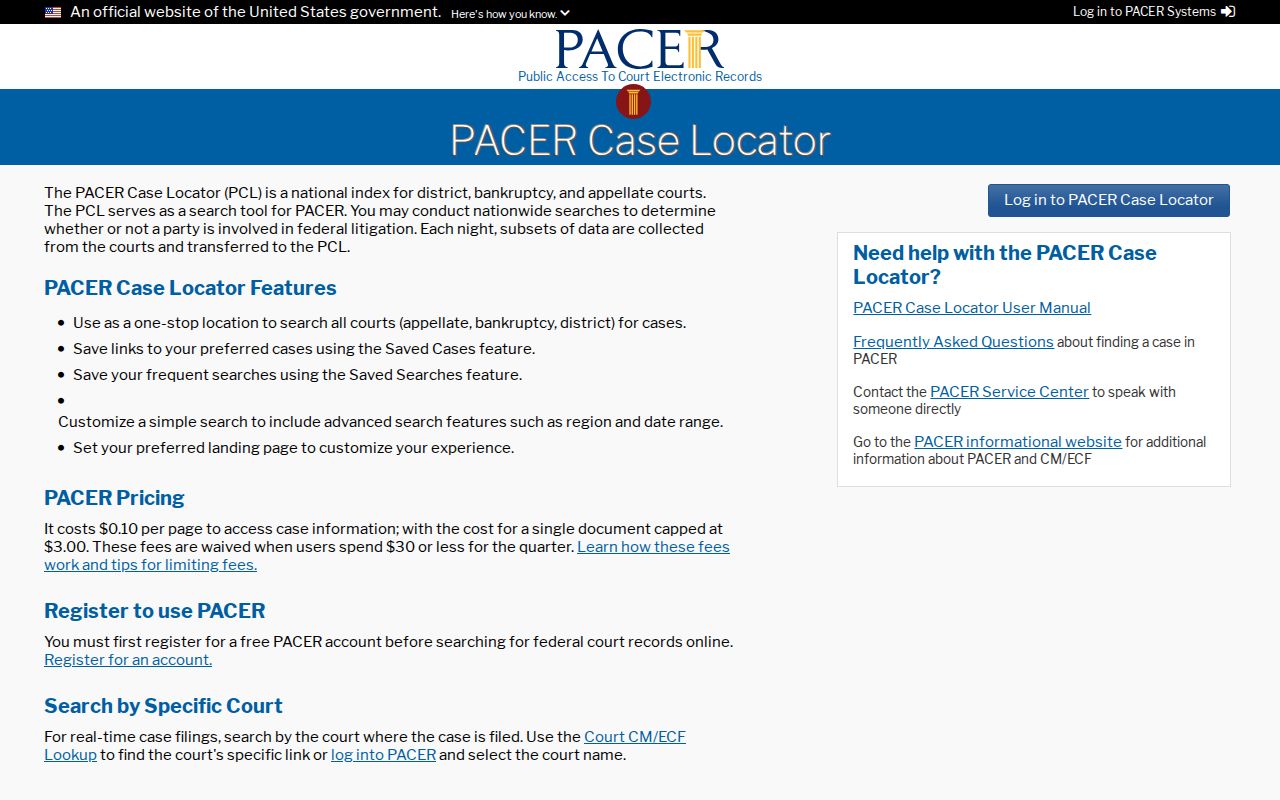
Federal party results can add a case number and district to a name timeline, but account rules, page charges, and sealed-file limits still apply.
Oakland Resident Results by Party Role
A docket is the court's running record of filings and events in a case. It is not a plain-language finding about a person. Read the case type, party role, filing date, and later disposition together. A petitioner, respondent, plaintiff, defendant, heir, attorney, or interested party carries a different meaning. A probate petition may name a decedent and heirs or devisees, while a public filing can still omit protected details.
| Result field | What it can show |
|---|---|
| Case number, title, type, filing date | The court matter and its place in a time line |
| Party names and roles | How the person appears in the matter, with attorneys where entered |
| Register-of-actions entries | Filing or event dates and short descriptions |
| Minutes and future hearing details | Public court events, departments, and scheduled dates |
| Document preview or download route | Whether a public image can be viewed, printed, or purchased |
| Absent or controlled material | Sealed, confidential, juvenile, adoption, or protected family content may not appear |
Do not treat an allegation as a disposition. A no-match also proves little because juvenile, sealed, confidential, and adoption records are restricted. Archived files may need a clerk or courthouse request, and certified copies carry court fees under the current schedule. A public terminal can help when remote access is limited, subject to California Rules of Court 2.500 through 2.507.
- Docket
- The running list of filings, events, and court actions tied to a case.
- Index versus image
- An index is a searchable summary. An image is the scanned document or preview behind that summary, with access and credit rules set by the custodian.
- Certified copy
- A copy issued or attested by the responsible court or records office for a permitted use. It is different from an index view or an informational copy.
The California Megan's Law registry is another example of a specialized official search with its own statutory warning and display limits.
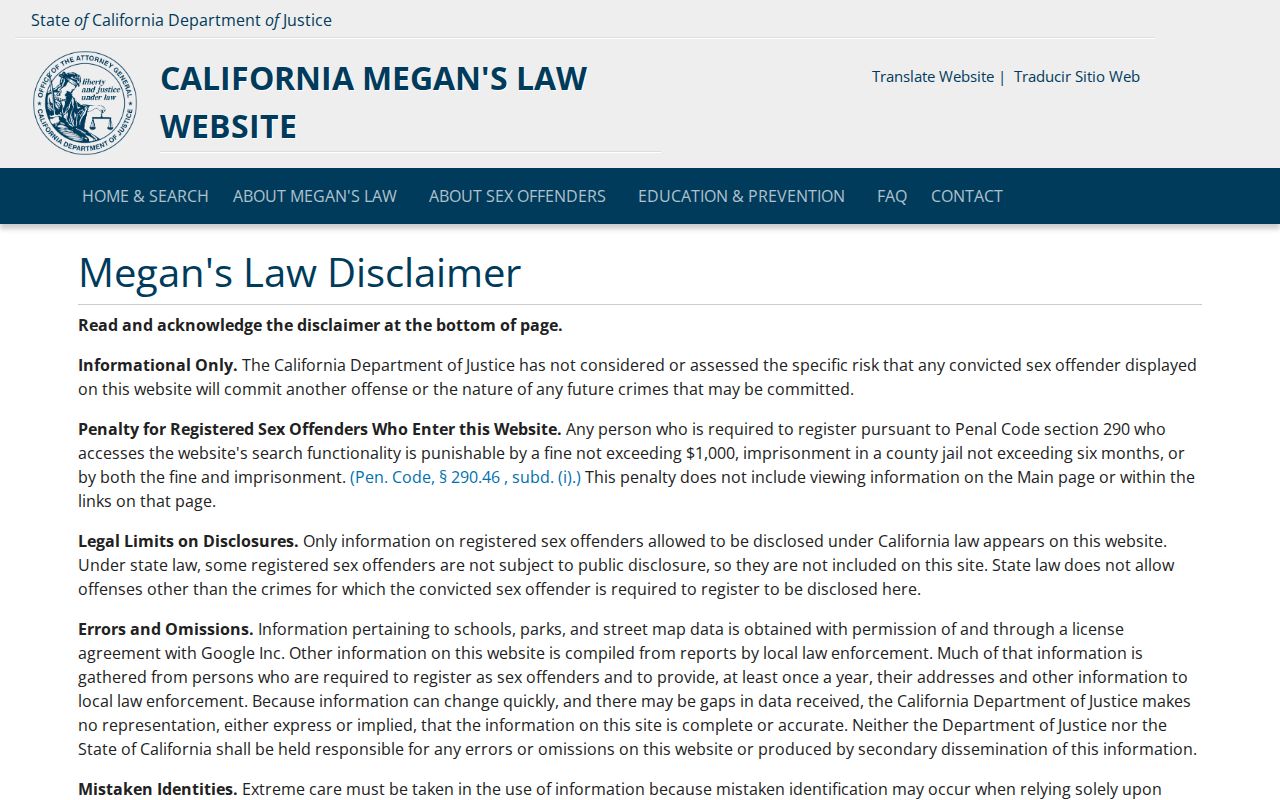
That registry uses name and map or address routes for the information legally displayed, so it should not be treated as a general resident directory.
Oakland Vital Records for Resident Verification
Vital custody is layered in Alameda. The local registrar handles births and deaths for the current and preceding year. The Alameda County Recorder holds local birth and death certificates in county custody and public marriage records when the license issued in Alameda County. CDPH-Vital Records maintains statewide events from July 1905. Oakland History Center sources reach earlier local births and deaths from 1870 through 1904.
California uses authorized and informational copies instead of a simple closed-for-years rule. An informational copy is generally available but carries a legend saying it is not valid to establish identity. An authorized birth or death copy requires an eligible relationship or role, and a mailed request uses a notarized sworn statement. Confidential marriage copies go through the county clerk under Family Code section 509. A divorce decree comes from Alameda Superior Court; the CDPH dissolution certificate is a limited index product, not the judgment.
- Copy choice, number of copies, and fee enclosed.
- Name on the record, event date, and event place.
- Parents' names or spouse details, as the record requires.
- Applicant contact fields, relationship, and purpose for an authorized copy.
- Printed signature, date, payment, and the notarized sworn-statement block for a mailed authorized request.
The VS 111, VS 112, and VS 113A forms ask for the copy choice, number of copies, name on the record, event date and place, parents or spouse as applicable, applicant contact fields, relationship or purpose, signature, and payment. A mailed authorized request also uses the sworn-statement and acknowledgment block. For 2026, CDPH lists birth copies at $31, death at $26, public marriage at $19, dissolution at $18, fetal death at $23, and stillbirth at $28. If no record is found, CDPH retains the fee as a search fee and issues a Certificate of No Public Record.
Note: An informational copy can confirm an event while carrying a legend that it cannot establish identity.
Oakland Voter Channels for Resident Checks
California voter tools are self-service verification routes, not open resident directories. Alameda My Voter Profile and the state registration-status tool ask for a first name, last name, date of birth, and identity fields that may include driver license, state ID, or Social Security digits. County or ZIP data can narrow the authentication. The result can include registration status, party preference, districts, precinct, polling or vote-center information, ballot status, and election materials. It does not reveal ballot choices.
Voter registration information is purpose restricted under Elections Code section 2194. The Secretary of State file application asks who is requesting the data, the organization and contact details, permitted purpose, security and storage plan, authorized users, requested files, and a certification under penalty of perjury. The statewide fee is $100. A specific voter request is $30 each, up to $100 and ten records. Home address, phone, email, prior registration, signature, driver or ID number, and Social Security or unique identifiers are protected outside authorized channels.
Alameda eData publishes aggregate registration statistics and maps, not a list of named voters. Historical Alameda voter registers from 1867 through 1944 are an Oakland History Center route for in-person research. A no-match can reflect list maintenance, a changed status, a protected record, or a wrong name variant. It does not prove that a person never lived at an Oakland address.
Oakland Heir and Classmate Trails
Personal questions often need a narrower trail than a modern name search. Probate petitions and notices can identify a decedent, petitioner, heirs, devisees, and filed mailing addresses, though protected filings may be withheld. Obituaries and newspaper indexes can connect a death signal to relatives. Deeds can then test an ownership link. A probate result remains a lead until the court role, dates, and later filings align.
Former classmates are better approached through OUSD yearbooks, school publications, alumni collections, Oakland History Center biographical files, and the African American Museum and Library at Oakland. The museum's finding aids and Calisphere material can restore names omitted from mainstream directories. California adoption records and original birth records are sealed absent statutory or court procedures. Birth-family research should use CDSS or CDPH statutory adoption-information and mutual-consent routes, not an attempt to bypass confidentiality.
For the historical shelf itself, the Oakland city directory collections keep the year runs and reverse-directory distinctions in one place.
Oakland History Center librarians provide two remote certificate, obituary, or directory lookups each month. That limited service can help test a historical name before an in-person visit. Keep the question focused, give a year range, and treat a librarian's result as a source lead that still needs the underlying custodian when formal proof matters.
Oakland Resident Lookup for Business Roles
A business connection is not the same as a residence. California bizfile Online searches an entity name or number and can show status, type, initial filing date, jurisdiction, principal or mailing address, agent for service, disclosed managers or officers, and filing history. An agent address is a service address. Alameda fictitious business name records add a trade name, registrant, and business address. Pair the role and filing date before linking a person to Oakland.
DCA Search can filter by board or bureau, license type, license number, business name, first name, last name, city, county, and ZIP. Typical results show a license number and type, name, public address of record where available, issue or expiration dates, status, and public discipline. Specialist routes include the State Bar, Contractors State License Board, Medical Board, Board of Registered Nursing, Department of Real Estate, and Commission on Teacher Credentialing.
The official California Controller unclaimed-property search uses last name or business name, first name, and city.
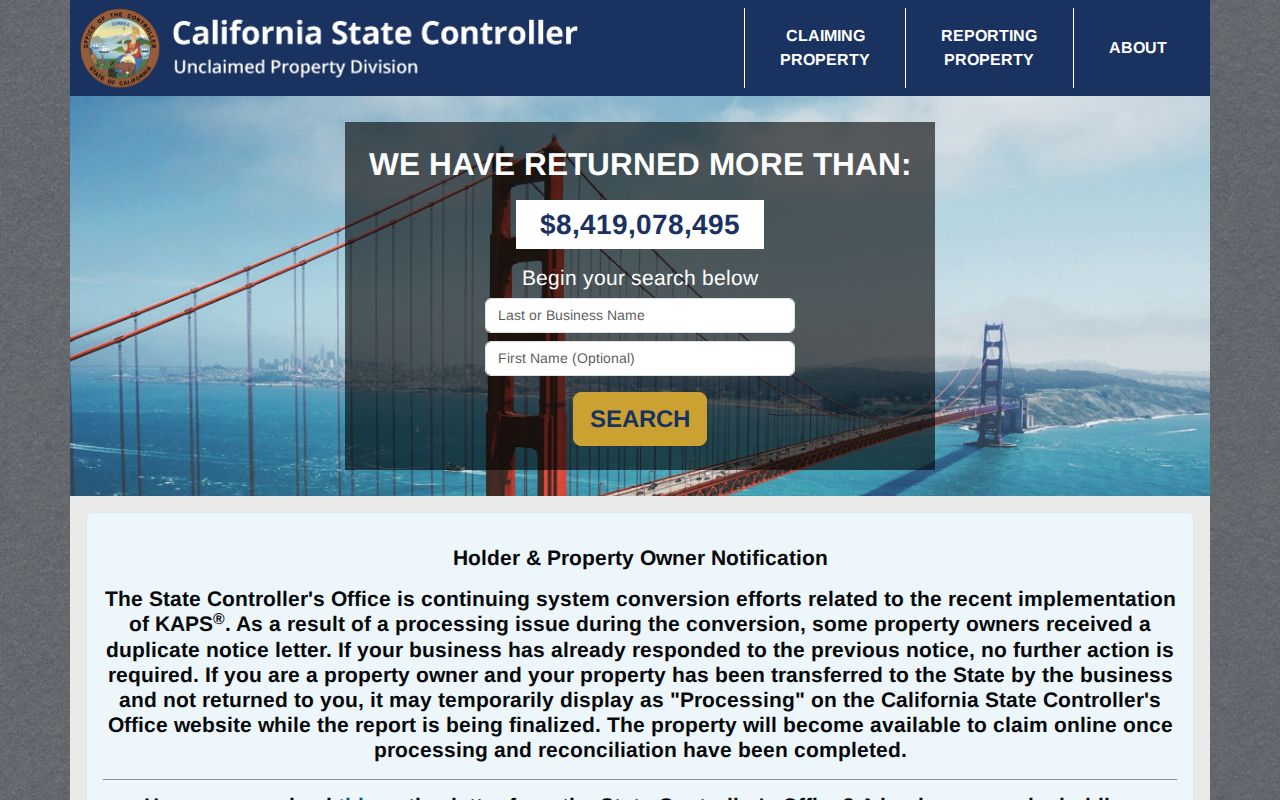
Its result can show an owner name, reported address or city, property ID or type, and reporting business, but an older reported address is not proof of a current Oakland residence.
Correct the Oakland Resident Lookup Source
A wrong result should be corrected where it was created. Assessment ownership questions go to the Assessor or the recorded-deed process. Court docket questions go to the court clerk or the court's correction, sealing, or relief route. License data goes to the responsible board. Voter data goes to the Registrar. A vital certificate uses its statutory amendment process. A directory cannot change any of those official sources.
The California Public Records Act, Government Code division 10, sections 7920.000 through 7931.000, lets any person request an identifiable existing record. An agency generally must determine within ten calendar days whether a request seeks disclosable records, with a written extension of up to fourteen days for unusual circumstances. That deadline is not always a production date. Exempt portions may be withheld while reasonably separable material is released. Oakland routes city requests through its NextRequest portal, while ordinary recorder copies, court files, and certificates follow their own order procedures.
Keep a request narrow. Name the agency, record type, date range, case or parcel clue, and the existing record sought. Do not ask an office to build a dossier from unrelated systems. A focused request is more likely to reach the right custodian and less likely to sweep in protected information.
Oakland Resident Lookup Privacy Limits
California privacy rules explain why a name search can stop short. The CCPA, as amended by the CPRA, gives covered consumers rights to know, delete, correct, opt out of sale or sharing, and limit certain sensitive-information uses. Public government-record information can fall outside parts of the CCPA definition, so removing a commercial copy does not erase a deed, assessment record, or court file.
The 2026 DROP system sends one encrypted deletion request to more than 500 registered data brokers, with broker processing duties beginning August 1, 2026. Safe at Home provides an eligible participant with a substitute mailing address, confidential voter registration, name-change procedures, and DMV suppression. Government agencies and courts generally accept the designated address, but the program cannot retroactively remove every old public reference. Voter confidentiality and the federal Driver's Privacy Protection Act add separate limits.
Lawful use. Use an Oakland resident lookup for personal research, family history, reconnection, estate questions, or source verification. Public availability never permits stalking, threats, impersonation, harassment, or evasion of a protective order; California Penal Code section 646.9 and other laws can apply.
Verify each important result with the office that holds it. Dates, party roles, copy type, and access restrictions are part of the record, not fine print.