
Finding People in the Oakland Residents Directory
Oakland has no single resident roll. A roll is a list kept for a defined purpose, so the county assessor tracks parcel and tax relationships, the elections office authenticates a voter, the courts index case parties, and the library preserves older households. A name, street, or historical year therefore starts a different search. Ownership is not the same as occupancy, and a court appearance is not a finding about a person’s character.
A practical Oakland residents directory search keeps those roles separate. Start with the strongest fact already known, write down its date, and move from one custodian to the next. Nonowners, children, unregistered adults, people using a substitute address, and households absent from a directory will not appear in every source. A missing match can reflect coverage or privacy rules rather than a mistake.
- Normalize the known name or street address, including an apartment or unit when it is known.
- Use the Alameda Assessor Parcel Viewer to connect a physical address with a parcel identifier and map location.
- Transfer a disclosed owner name to the Clerk-Recorder’s grantor and grantee index, then inspect the instrument and legal description.
- Use the Alameda and California voter tools only for an authorized self-lookup, and use Oakland History Center registers for historical residence clues.
- Match court, vital, directory, obituary, or city records by role and date, then ask the responsible office for an existing record when a web search ends.
The result is a chain of clues, not a master list of every Oakland household. The chain becomes more useful when a parcel, a middle initial, a spouse, an occupation, or a dated event supplies a second anchor.
Oakland Resident Records Offices
Oakland is Alameda County’s seat, so several custodians with countywide reach operate counters in the city. The Clerk-Recorder handles recorded instruments and vital-record copies. The Assessor maintains parcel maps and assessment material. Elections maintains self-service registration tools and purpose-limited voter-file access. The City Clerk and city departments keep municipal records, while the Superior Court holds case records for Oakland matters.
The Alameda County Clerk-Recorder service hub is the best starting point when the question could involve a deed, marriage record, birth or death record, fictitious business name, or notary filing. Its services are distinct from a current resident list. Each office labels the role that a record can support, which prevents a taxpayer, applicant, voter, or court party from being mistaken for every person at an address.
The Clerk-Recorder service page also shows the countywide counter functions behind Oakland’s recorded and vital trails.
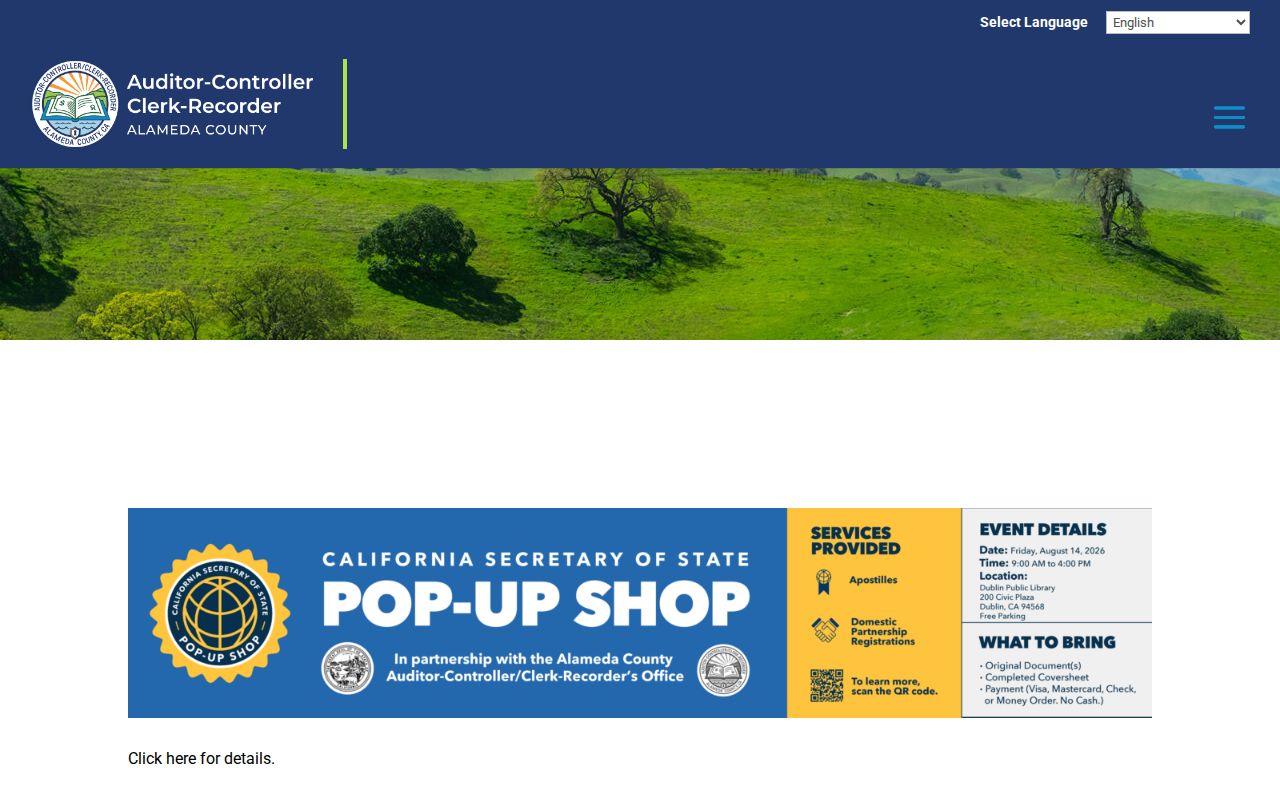
That service map clarifies which questions belong with the Recorder and which belong with another custodian, a useful check before ordering a copy or filing a request.
Counter access matters when a web index stops. The recorder’s older books, the Assessor’s map desk, and the library’s local-history room each supply a different fallback. Bring a narrow date range and a known address or name so staff can route the request without creating a new directory.
Alameda County Clerk-Recorder
1106 Madison Street
Oakland, California
510-272-6362 or 888-280-7708
Official Public Records
Alameda County Assessor
1221 Oak Street, Room 145
Oakland, California
510-272-3787
Assessor Parcel Viewer
Alameda County Elections
Registration and voter records
Oakland, California
510-272-6933
My Voter Profile
From an Oakland Address to a Parcel
An address search starts with the Alameda Assessor Parcel Viewer, a map interface keyed to a situs address or APN. APN means assessor parcel number, the county identifier used to find a mapped land unit. Enter the address, choose the normalized match, and record the parcel before drawing conclusions from any owner or mailing field.
The map helps place the address among Oakland parcels, but it is assessment cartography rather than a legal survey. Aerial alignment can be approximate, recorded changes may lag several weeks, and an APN can change after a subdivision, combination, or boundary adjustment.
| Address | Text or autocomplete route for the physical situs address; select a match. |
|---|---|
| APN | Text route for the county parcel identifier; hyphenation may be normalized. |
| Map pan and zoom | Browse nearby parcels and a street segment without a name search. |
| Parcel click or select | Open parcel attributes, map references, and the selected land unit. |
| Layers and basemap | Use parcel and reference geography; exact layer choices can change. |
| Print or map output | Assessment map reference only, not a boundary survey. |
Keep the situs address, the mailing address, and the legal description in separate notes. A mailing address tells where notices go. It does not establish where an owner or any other resident lives. The parcel is the bridge from a street clue to a recorded land record.
Note: The Assessor viewer gives a strong starting clue, but recorded instruments and the legal description control title questions.
Current Oakland Resident Directory Sources
Current Oakland directory work is a comparison of partial sources. The Assessor can show a parcel and, where public, an owner or taxpayer relationship. The recorder shows parties to instruments. A voter tool authenticates the voter who is using it. Courts show parties and roles in a case. City permit records show an address, project, and disclosed contacts. None is a complete list of everyone who lives in Oakland.
| Source | Who It Lists | Keeper | Access |
|---|---|---|---|
| Assessor Parcel Viewer | Parcel owner or taxpayer clues when disclosed | Alameda Assessor | Free map and counter access |
| Official Public Records | Grantors, grantees, borrowers, and other instrument parties | Alameda Clerk-Recorder | Free index from 1969; copies paid |
| Voter status tools | An authenticated voter’s registration and election information | Alameda County and California SOS | Self-lookup; files are purpose restricted |
| Court portals | Parties, case roles, filings, and register entries | Alameda Superior Court | Case-dependent account or registration |
| Oakland permit search | Applicants, owners, contractors, projects, and dates | Oakland Planning and Building | General records after 1987; roles vary |
Use the source that matches the question. A parcel is useful for an ownership lead, a deed for the legal record, a court docket for a filed party role, and a city permit for project chronology. When the question shifts from a whole Oakland street to its address chain, the Oakland street directory workflow keeps the parcel, deed, permit, and historical layers in their proper order.
Why Oakland Deeds Start With Names
Alameda’s recorded-document index is organized by parties, not by Oakland street address or APN. A grantor is the party conveying an interest, while a grantee receives it. Start with the current owner name from the parcel trail, search that person or entity as grantee, and compare the resulting legal description with the parcel. Search the earlier grantor as a later grantee to move backward through the chain.
The Alameda Official Public Records portal displays the recorder’s name-led route and order choices.
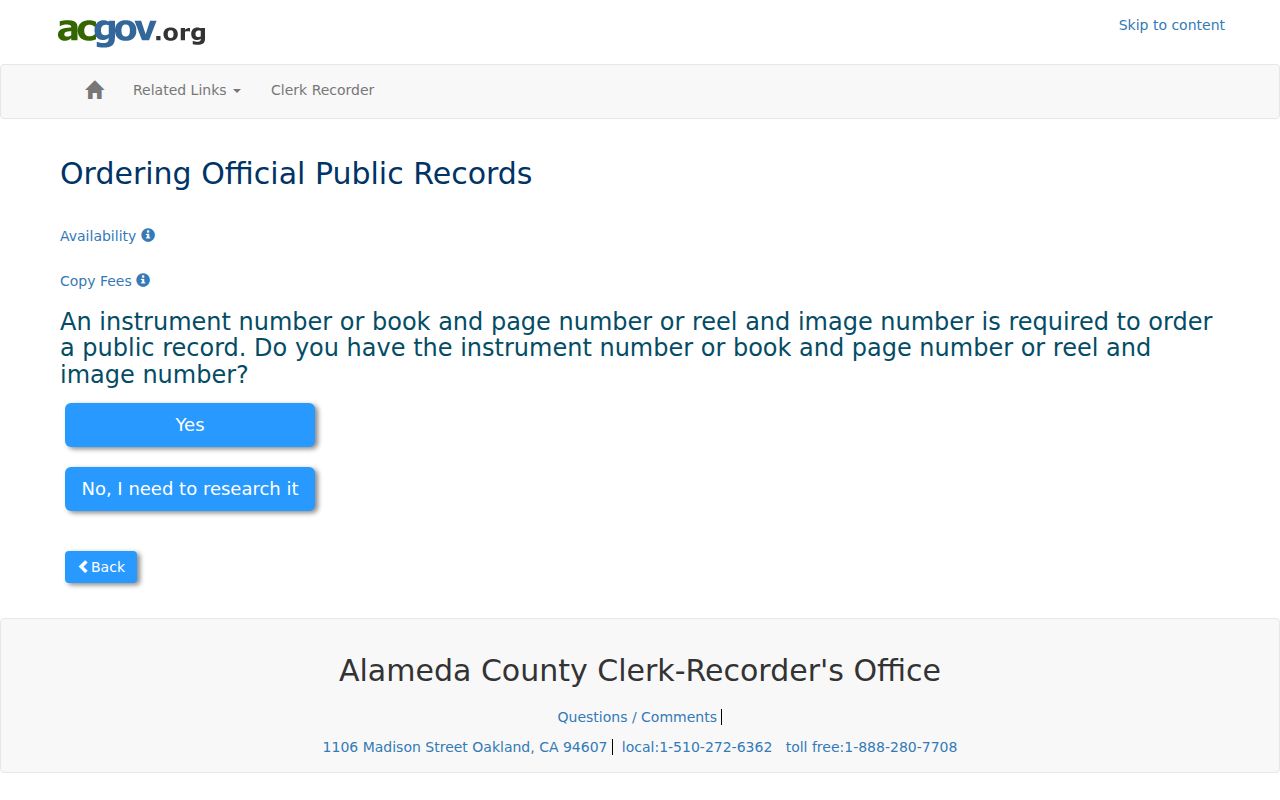
The electronic name index covers 1969 to the present. Official records themselves reach back to 1853, but research for 1853-1968 is done in person at 1106 Madison Street. The index is a locator, not proof of occupancy. Plain copies are $3.50 per page; certified copies cost $4.50 for the first page and $3.50 for each added page. New documents can take about two weeks to become orderable, and older or high-page-count requests may take longer.
Useful index and image fields include the party identity as submitted, recording date, instrument number, book and page or reel and image, document type, and the legal description in the document. Deeds, deeds of trust, reconveyances, liens, notices, and maps answer different questions. A same-name hit needs an address, parcel, spouse, middle initial, or dated role before it becomes a reliable Oakland residents directory clue.
Note: A recorded index entry locates a document; the image and legal description are needed when a name match could belong to another Oakland parcel.
Oakland Voter Records and Self Lookup
California voter tools are designed for a voter to retrieve their own registration information, not to browse an Oakland street. The Alameda My Voter Profile and the California registration-status tool use identity fields such as first name, last name, date of birth, and tool-dependent driver license, state ID, or Social Security digits. County or ZIP information can help narrow the authenticated record.
The state status route may return registration status, registered name or party preference, districts and precinct, polling or vote-center information, ballot status, and election materials. It does not reveal ballot choices. Home address, telephone, email, prior registration, signature, driver or ID number, Social Security number, and unique identifiers are protected except through authorized access.
A voter file is a different channel. Elections Code section 2194 limits access to election, scholarly, journalistic, political, or governmental purposes, with certification and security duties. An approved file can include residence and precinct fields, but ordinary personal searching cannot turn it into an open Oakland residents directory. Historical Alameda voter registers from 1867-1944 are available for in-person work at the Oakland History Center.
The state voter-status page shows the self-service route that protects this distinction.
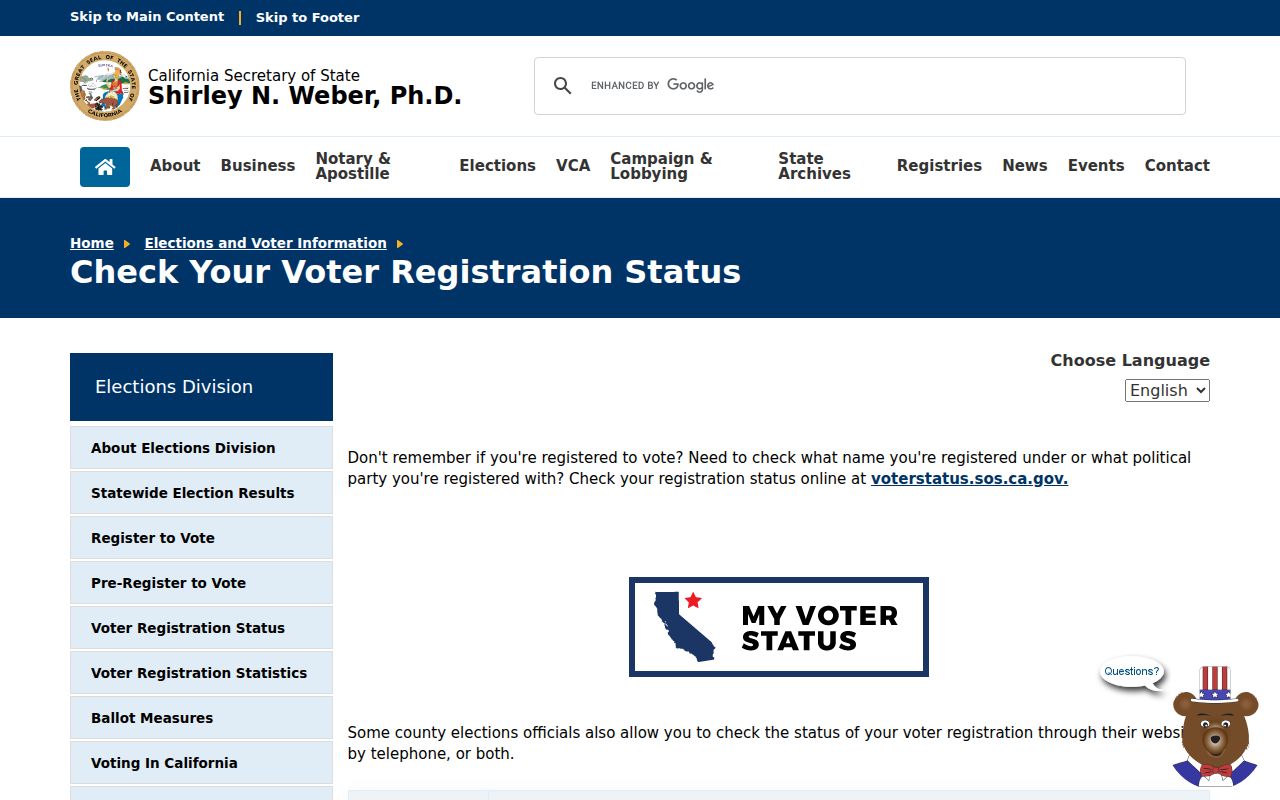
That boundary explains why a no-match cannot prove that a person never lived at an Oakland address. The record may be inactive, confidential, outside the permitted search channel, or simply absent from the voter roll.
Oakland Court Searches Use Two Portals
Alameda Superior Court separates public access by case type. Civil, small claims, family, probate, mental-health, and adoption information flows through eCourt, while criminal hearing and Smart Search work through an Odyssey route that requires registration. The court’s public portal directory makes the split clear for an Oakland name search.
The Alameda court portal page shows the separate case routes used for local court research.
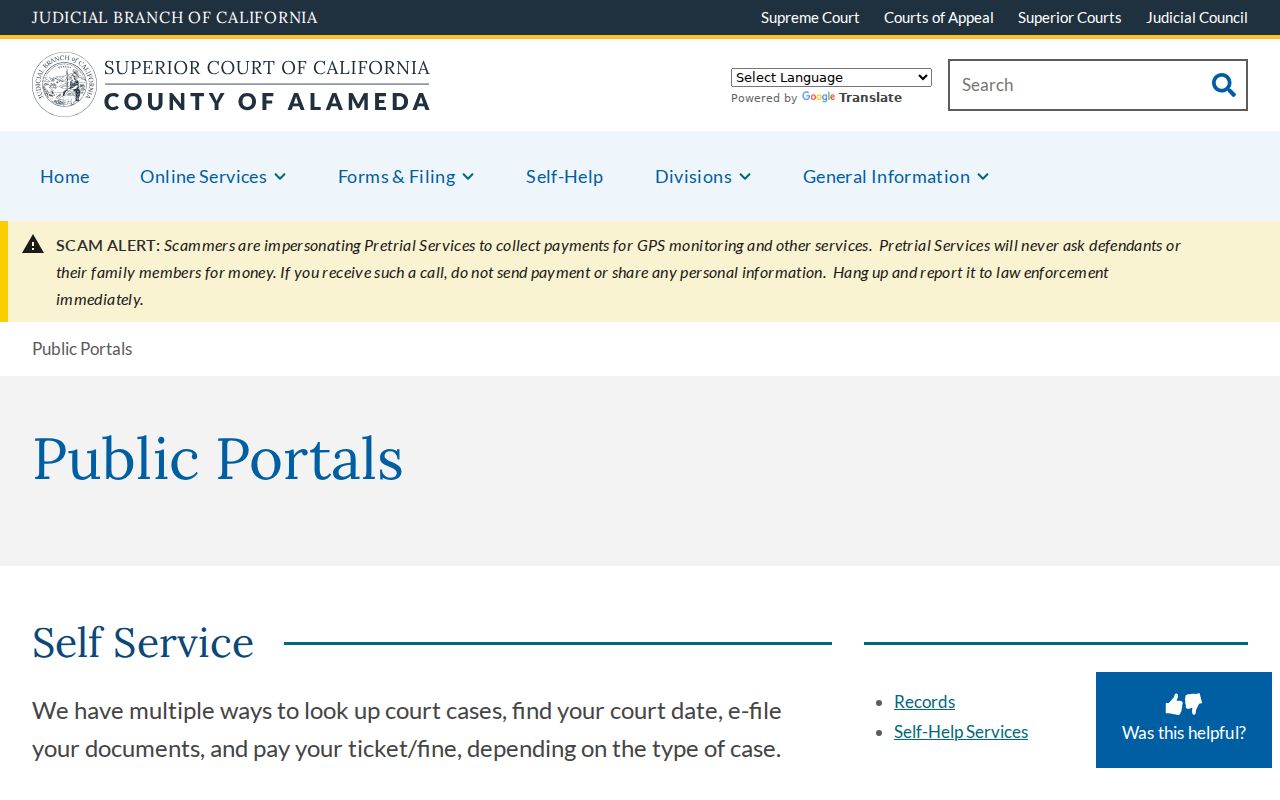
In eCourt, a name search can lead to a case number, while a case-number search is the free direct route to party and register-of-actions data. Accounts and credits apply to many name searches, documents, downloads, or printing. Criminal hearing search accepts a case number, case type, CEN, PFN, hearing or filing date range, partial name, and department number.
Public courthouse terminals can help when remote access is limited, and archived files may require the clerk or courthouse to retrieve them. Certified copies carry court fees that should be confirmed with the court. The access channel changes, but the need to record a party role and case type does not.
- Case number, case title or type, and filing date identify the matter.
- Party names, roles, and entered attorneys show who appears in what capacity.
- Register-of-actions entries record filing or event dates and descriptions.
- Minutes, future hearings, departments, and document previews appear only where public.
A party is not automatically a defendant, and an allegation is not a disposition. Sealed, confidential, juvenile, protected family, and adoption information may be absent. Court evidence becomes stronger when a party role, filing address, middle initial, attorney, and date align with a separate Oakland record.
Oakland Vital Records, Indexes, Copies
Vital records use a layered custody system. Alameda County Public Health is the local registrar for the current and preceding year. The Alameda County Recorder holds all-year county birth and death records and public marriage records when the license issued in Alameda County. The California Department of Public Health maintains statewide events from July 1905. The CDPH vital-records route supplies forms and copy rules.
California does not use a simple rule that opens every record after a fixed number of years. Authorized certified birth and death copies require a permitted relationship or role, and mailed authorized requests use a notarized sworn statement. Anyone may generally request an informational copy, which is marked not valid to establish identity. Public marriage copies are available, while confidential marriage copies are limited under Family Code section 509. Adoption files and original birth records remain sealed unless a statutory or court process applies.
The 2026 state fees are $31 for a birth copy, $26 for a death copy, $19 for a public marriage copy, and $18 for a dissolution certificate. A dissolution certificate is an index product, not the Superior Court decree or its full terms. County fees and pickup rules should be checked with the live county office. An Oakland residents directory search should treat a vital index as an event clue until the proper custodian supplies the record.
Oakland History Center Directory Shelf
The Oakland History Center is the strongest local substitute for a current residents roll when the question reaches into family history. Its holdings include Oakland city directories from 1869-1943, selected reverse directories from 1936 through 1995, Alameda County voter registers from 1867-1944, Oakland birth and death certificates from 1870-1904, obituary files, newspapers, block books, Sanborn maps, school publications, maps, manuscripts, and community archives.
The Oakland History Center collection page explains the local-history scope and reference service.
Materials do not circulate. Appointments are recommended. The center offers up to two lookups per month for Oakland birth or death certificates, death notices, obituaries, directories, and local indexes. Its pages list 510-238-3134 and 510-238-3222 for the center, with eanswers@oaklandlibrary.org for questions. Email or phone responses are stated as within three business days; mailed requests take about one to three weeks.
Some city directory years were not printed, including 1919, 1920, 1929, 1931, 1932, 1936, 1942, 1944-1966, and 1968. Reverse directories organize by address or phone, so they can show a street or block when an alphabetical name search fails. The historical Oakland city directory page carries the collection-by-collection reading method and the caution about publication gaps.
Note: A library gap year is a publication gap, not proof that no Oakland household existed or that a person left the city.
A Human Check for an Oakland Resident
Oakland’s size creates same-name collisions. The 2020 decennial census counted 440,646 people, and a name-only hit can join unrelated households. A human-use workflow is safer when it builds a dated timeline and asks what each record actually proves: a deed shows a party to an instrument, a license shows a professional credential, a probate filing can identify an heir or petitioner, and an obituary can connect relatives without claiming a current address.
- Roll
- A purpose-specific list, such as an assessment or voter roll, rather than a complete list of every Oakland household.
- Index
- A locator that points to a record, party, date, or instrument; it is not the full image or certified copy.
- Parcel
- A mapped land unit identified by an APN and used for assessment and property administration.
- Criss-cross directory
- An address- or phone-ordered directory that supports a move from a street clue to a listed occupant.
The California Department of Consumer Affairs license search is useful when a public professional role needs checking.
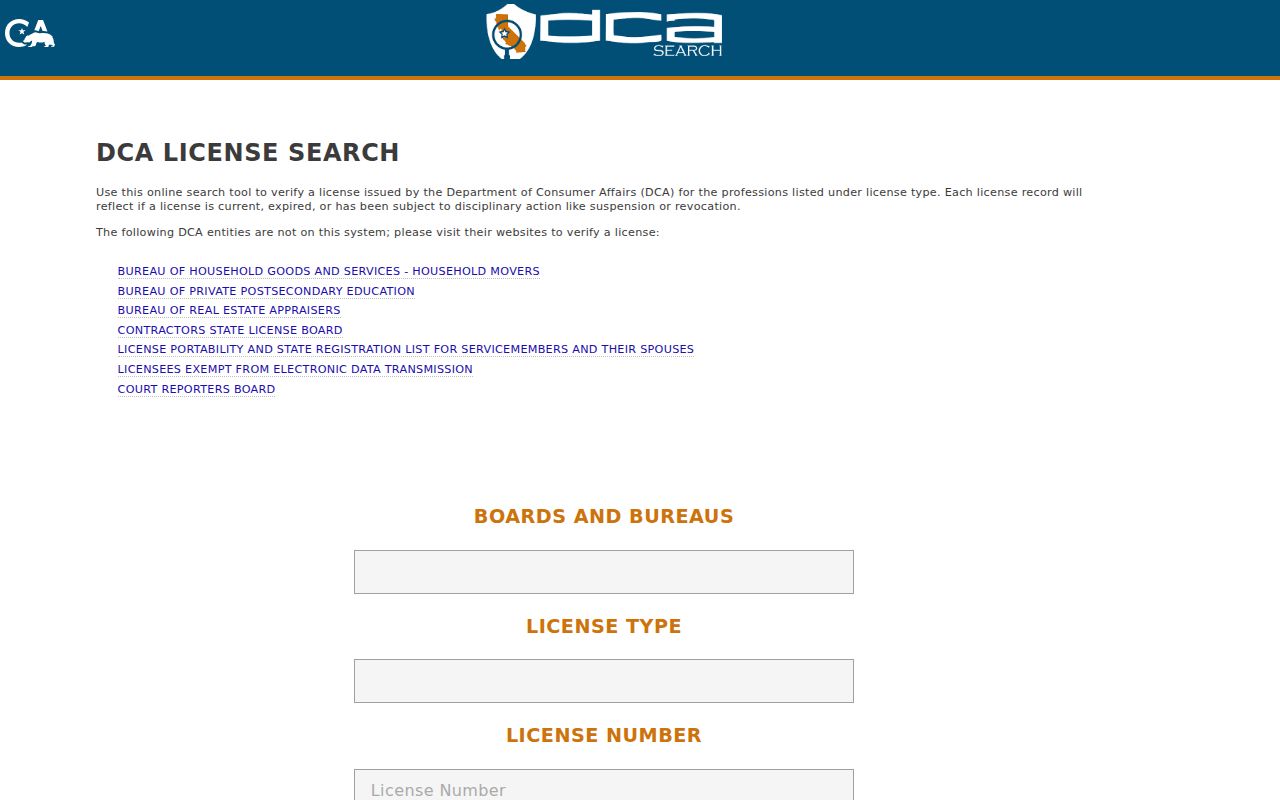
License results can show a license number or type, name, address of record where public, issue or expiration dates, status, and public discipline. An address of record describes the license relationship, not necessarily a home.
For a business-related name, the California Secretary of State bizfile search can show an entity number, status, type, jurisdiction, principal or mailing address, agent for service, disclosed managers or officers, and filing history.
An agent address is a service address, not necessarily a residence. Pair a business filing with a parcel, deed, city permit, or Fictitious Business Name record only when the roles align. For family history, a probate petition, obituary, directory entry, and deed can reconnect an heir trail without turning an uncertain name into a claim about a living household.
| Approach | Useful clue | What to verify |
|---|---|---|
| Official custodian | Parcel, deed, court, voter, vital, or license record | Role, date, coverage, and the office’s access rule |
| Historical collection | Directory, voter register, obituary, map, or school publication | Publication year, indexing convention, and whether the item is secondary evidence |
| Commercial compilation | Aggregated public, marketing, and inferred relationship clues | Stale addresses, merged same-name people, and the original custodian |
Where Oakland Public Searching Stops
Some absences are built into the records map. Nonowners and household members may not appear in parcel data. Utility customer lists and DMV personal data are not open resident directories. Sealed court files, juvenile matters, adoption records, protected voter fields, confidential marriages, and Safe at Home records are intentionally limited. A city staff directory identifies a public role, not a person’s home.
When an agency plausibly holds an existing disclosable record, a targeted request can use the California Public Records Act, Government Code division 10, sections 7920.000-7931.000, or Oakland’s Sunshine Ordinance in Municipal Code chapter 2.20. Ask for an existing database export, log, roster, index, or record, and name the department, address or person, and date range. Agencies do not have to create a new directory or answer an open-ended question.
The Oakland NextRequest portal lets the public browse request material and submit a focused city request.
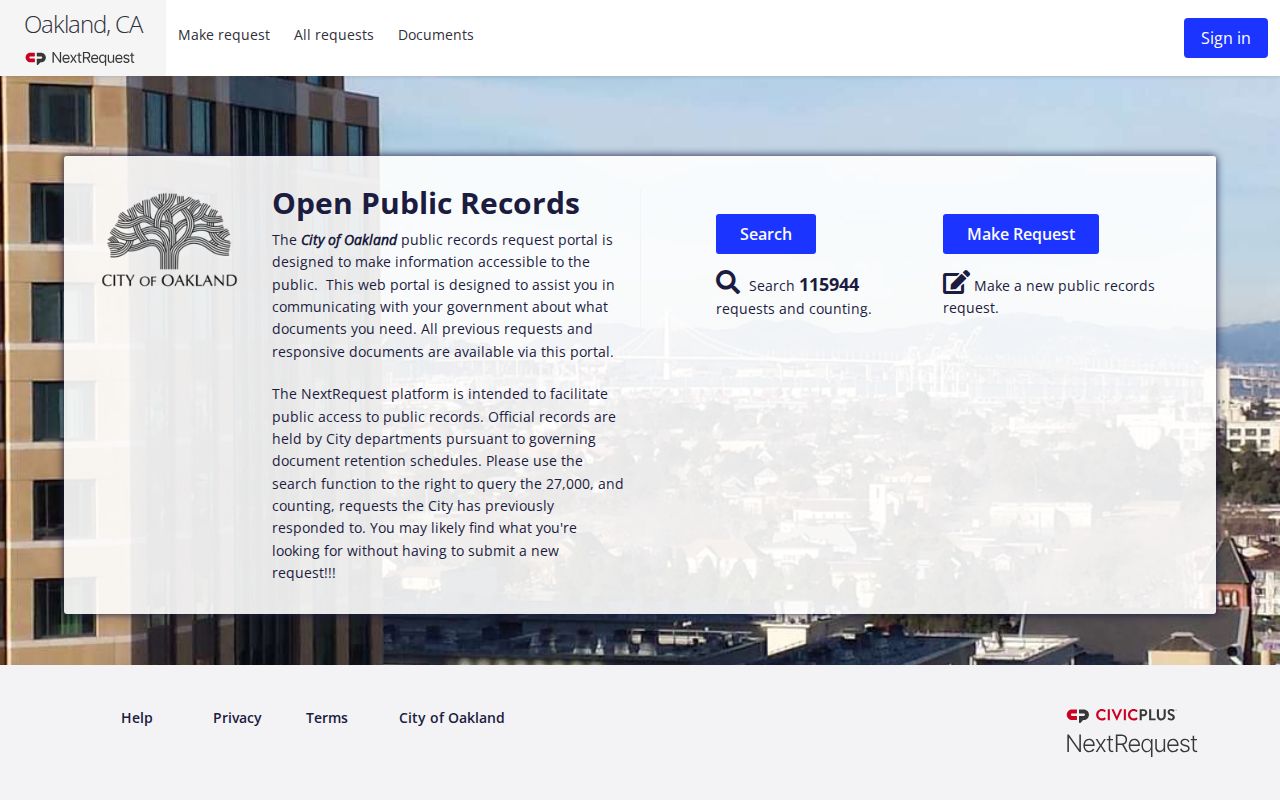
California agencies generally make an initial determination within 10 calendar days, with a written extension of up to 14 days for unusual circumstances. That deadline is not the production deadline. Ordinary recorder copies, court files, and vital certificates follow their own purchase or court-access procedures rather than a CPRA shortcut.
Safe at Home and Oakland Address Privacy
California privacy rules explain why an Oakland address may not appear even when a related record does. Safe at Home, under Government Code sections 6205-6211, provides a substitute mailing address and confidential voter registration for eligible participants. State and local agencies and courts generally accept the designated address, and qualified participants can use a statutory procedure to substitute it in specified real-property instruments. The program does not erase every old public reference.
Voter confidentiality provisions protect home and contact data except through authorized channels. The California Consumer Privacy Act, as amended by the CPRA, gives covered consumers rights to know, delete, correct, and opt out of sale or sharing. The state’s 2026 DROP system can send one encrypted deletion request to more than 500 registered data brokers, with processing duties beginning August 1, 2026. Deleting a commercial copy does not delete a deed or assessment record.
Safe at Home information describes the substitute-address system, while California Attorney General CCPA guidance explains consumer privacy rights.
Lawful personal use. Oakland records support lawful research, family history, civic understanding, and address questions. Do not use names, addresses, or record clues to stalk, harass, intimidate, impersonate, or evade a protective order.
Historical Oakland Resident Directories
Oakland’s historical resident directories are strongest when the question concerns a past household, not a current universal roll. Husted’s Oakland, Alameda and Berkeley Directory, R. L. Polk & Co. volumes, and Bishop’s Oakland directories appear across the local and digitized record. Alphabetical entries can pair a name with an address, spouse notation, occupation, or residence marker. Reverse and criss-cross volumes turn the same question around by beginning with an address or phone number.
Use the year printed on the volume, read its abbreviation key, and record the street exactly as shown. A moved household, nonpublication year, changed street name, or indexing convention can explain a break. Older entries can support family history when paired with voter registers, census schedules, obituaries, block books, or deeds, but they do not establish a present Oakland residence.
Oakland Records by Era
Oakland’s record trail makes more sense as a sequence of handoffs. The county, city, state, court, and library did not begin the same collection at the same time. These milestones show why an Oakland residents directory search must switch custodians as the question moves backward.
- 1853: Alameda County was created, and the Clerk-Recorder’s official-record coverage begins with the county.
- 1867: Alameda County voter registers begin in the Oakland History Center’s historical collection.
- 1869: Oakland city directory coverage begins, with later nonpublication gaps that must be checked year by year.
- 1870-1904: Oakland’s early birth and death certificates bridge the period before statewide California registration in July 1905.
- 1877-1925: Oakland assessor block books preserve owner, value, and parcel-change evidence in the History Center Map Room.
- 1969: The Alameda electronic official-record name index begins, while earlier deed research remains in person.
- 1987 onward and 2021: Oakland’s permit portal advertises general records after 1987, and Alameda Superior Court’s new civil case system launched on October 12, 2021.
Note: An Oakland records timeline is a set of dated clues, not a single proof of present residence.